

Get Involved in Newton
Local Sustainability-Related Organizations
We are a grassroots organization working to end fossil fuel dependency and secure a just transition to a clean energy future.
Learn more
Bike Newton, a 501c3 organization, aims to promote bicycling as a viable method of transportation in Newton, Massachusetts. Bicycling should be safe and convenient for all. Learn more
Its mission is to encourage Newton citizens to switch to all-electric driving.
Learn more

A community organization dedicated to preserving and improving Cold Spring Park.
Learn more

Our organization’s mission is to organize and support the maintenance, preservation, enhancement and improvement of Edmands Park. We also aim to promote safety, cleanliness, and functionality within the park while maintaining its current use.
Learn more
Friends of Tasun Community Garden at Spears Park
The Friends group will promote connection between gardeners at the community garden, help keep the site clean and attractive, and support fund-raising, education, and community events around the garden space.
Learn more

Green Newton is dedicated to creating an environment in better balance with the natural world by making significant, measurable improvements in the way we use resources.
Learn more
The League of Women Voters has two separate and distinct roles:
Voter Service
Education
Action/Advocacy
Learn more


We advocate for strong local policies and state laws to create a healthy climate and a livable future for all children.
Learn more
Newton Community Farm is a local non-profit farm focused on sustainability, education and community.
Learn more
Newton Conservators Inc. promotes the protection and preservation of natural areas, including parks, park lands, playgrounds, forests and streams.
Learn more
We are Newton residents. We advocate for protecting our existing tree canopy in addition to planting more trees. We protest unnecessary cutting of trees as damaging our community.
Learn more

Newton for Everyone is dedicated to promoting housing opportunities for people of all ages, means, backgrounds and abilities in Newton.
Learn more
The Newton Tree Conservancy is a nonprofit organization in Newton, Massachusetts established in 2008 to restore, enhance and protect Newton’s Urban Forest.
Learn more

To promote a shift towards a just, plant-based food system that would enable us to live safely within our planetary boundaries and reforest the Earth.
Learn more
What You Can Do

-
In the “at home” category, our most important advice is to get a Mass Save assessment and implement its findings. We know it can be challenging to miss work for a few hours to stay home to get a Mass Save audit, but it’s worth it!
The audit may recommend improvements such as insulation and air sealing, which reduce your heating and cooling costs and make your home more comfortable (and quieter!). A well-sealed and insulated home acts like a thermos, keeping heat out in the summer and in during the winter. You’re already paying for this service through your utility bills. Use it!
-
Planning for electrification is the smartest approach for both our climate and your wallet. Your furnace, water heater, or gas stove may fail without warning, creating the need for expensive emergency action. However, the moment of failure represents a good opportunity to stop investing in outdated, high-emissions systems. We encourage Newton residents and businesses to proactively plan for the end-of-life of fossil-fuel systems and appliances now by researching high-efficiency electric alternatives, such as heat pumps, induction stoves, and electric dryers.
-
Investing in solar panels yields financial savings—often free electricity after a 5-8-year payback period—a reduced carbon footprint, and energy security and independence. Solar power is more affordable than ever, with residential and commercial solar system costs having decreased by 64% and 69% respectively over the past decade (NREL). For homeowners or businesses prioritizing resilience, pairing solar with a battery storage system ensures you maintain power for essential needs during a grid outage. (Read more here about solar and resilience.)
Buildings: At Home and Work
Use Less, Electrify, Solarize
-
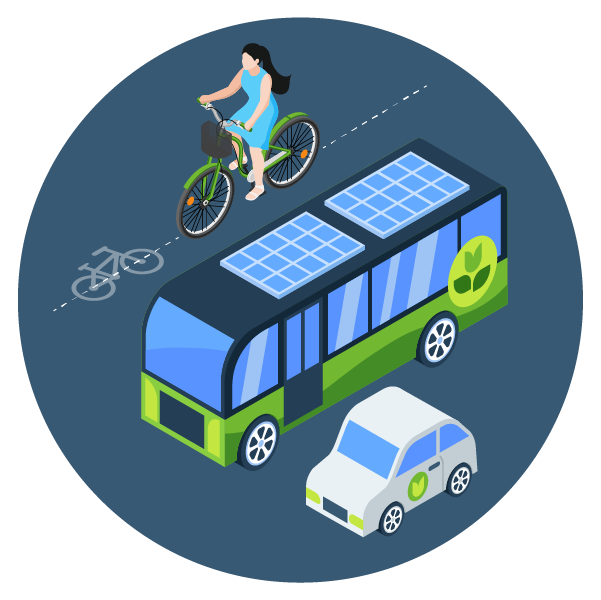
“Use Less and Green the Rest” in transportation translates into limiting driving when possible, and walking, biking, and taking public transportation when that’s an option. Electric bikes are a boon and can work for ferrying small children and hauling groceries (learn more about electric cargo bikes from this article).
-
When it comes time to buy your next car, consider purchasing an electric vehicle. Electric vehicles have numerous benefits, both environmental and financial. Electric vehicles produce zero tailpipe emissions, reducing local air pollution, and they have a lower lifetime carbon footprint than a comparable gasoline car. The long-term operational savings—namely fuel savings and lower maintenance costs—are also compelling. Through the MOR-EV rebate, buying or leasing an EV is more affordable for Massachusetts residents, businesses, and non-profit organizations.
-
We recognize that flying can’t always be avoided but recognize as well that aviation is responsible for 3.5% of anthropogenic climate changing emissions, according to a study led by UK’s Manchester Metropolitan University. Reducing airplane flights is an impactful way you can reduce your climate-related emissions.
Transportation: On the Road
Walk, Ride, Electrify
-
About a third of the country’s food is wasted, according to the USDA. Wasted food incurs unnecessary costs, including in emissions from farming and the transportation of food. Here are some strategies for avoiding food waste:
Plan meals and shop mindfully (at the very least, not when ravenously hungry).
Store food properly.
Use common sense regarding expiration and “best by” dates (but take these dates seriously for infant formula): If the food looks, smells, and seems fresh, it is probably okay to eat.
Serve meals on smaller plates.
Consider buying from sources like Imperfect Foods and Misfits Market.
If you have food waste, compost it to reduce the carbon footprint associated with waste hauling and disposal. Compost can also be used to build soil health and supply nutrients to plants.
-
Meat, especially beef and lamb, as well as dairy products, have the biggest diet-related greenhouse gas emissions.
Plant-based foods—including fruits and vegetables, whole grains, beans, peas, nuts, and lentils—have much smaller climate footprints (learn more from the UN). A vegan diet—avoiding all animal products—is the gold standard of environmentally sensitive eating. We understand that for many, if not most, people adopting a full-time vegan diet is too challenging. But the perfect need not be the enemy of the good. Take small steps. Forego, or limit consumption of beef and lamb. Three meals with meat per week is better than four!
However, from a climate perspective there is a risk of replacing meat with dairy for protein. Although dairy products have nowhere near the climate impacts of beef or lamb, most dairy products do come from cows. For climate purposes, foods such as beans, lentils, whole grains, and nuts are better protein choices.
-
While many purchases are necessary, such as clothing and household goods, buying less reduces all the emissions associated with the production, transportation, and disposal of the “stuff.” In fact, buying less is one of the most straightforward (and inexpensive) ways to live more sustainably.
There are many ways to buy items second hand, and even to rent certain items (for example, explore options like Rent the Runway). Check out local reuse programs like Newton’s Library of Things, the Swap Shop, and the Book Shed.
There are also opportunities to fix some items that have the potential for a longer life, through Fix-it Clinics held a few times a year at the Newton Free Library.
-
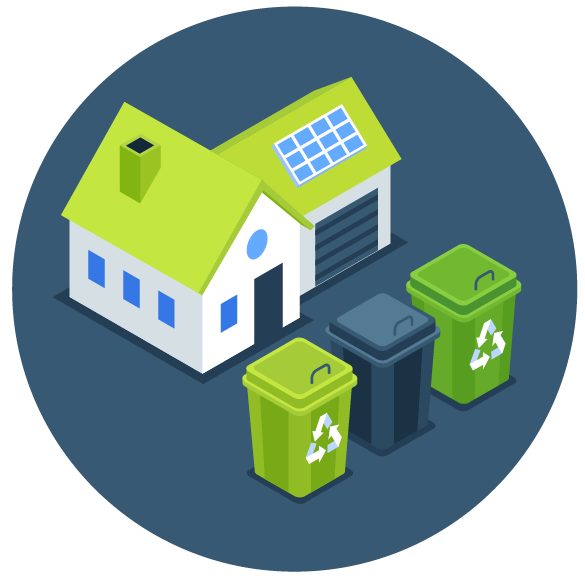
While throwing materials into the trash cannot be completely avoided, it can be minimized. One way to start is by aiming to get the highest and best use of materials before they end up as trash. Instead of following a linear "take-make-dispose" model, a circular approach emphasizes the actions laid out in this waste hierarchy diagram, including reducing, reusing, recycling, and composting.
The Newton Resource Recovery Center collects over 25 types of materials, including excess single stream recycling and cardboard (in the event your green bin is full), old electronics, scrap metal items, household hazardous waste (pesticides, fertilizer, cleaning products, etc.), batteries, light bulbs, and more. You can deposit used clothing, footwear, bedding, and towels in any condition in the “Helpsy” bins located at most public schools and at the Rumford Avenue Resource Recovery Center. For businesses and institutions, sector-specific recycling guidance is available from RecyclingWorks. You can compost food waste in your backyard, by using Newton’s Black Earth curbside service (see this list of acceptable materials), by using for free the City’s drop-off bins (learn more about this no-cost program here, and register here to get the lock combination for the drop-off bins).
Consumption: With Intention
Use Less, Buy Mindfully, Limit Waste
-
To prepare your home for potential flooding, start with preventive measures in the basement. You can waterproof your basement by sealing foundation cracks and installing a sump pump, ideally with a backup power supply. To protect vital building systems from water damage, you can elevate or relocate appliances such as your air conditioner, hot water heater, and furnace.
Improve drainage around your home’s foundation by grading away from your foundation and cleaning gutters and downspouts regularly. Replace impervious surfaces with permeable pavers, gravel, or vegetated areas in order to allow for rainwater infiltration.
Consider installing green infrastructure to soak up rainwater: canopy trees, rain gardens, rain barrels, and pollinator gardens can help capture rainwater, reduce erosion, and, in the case of pollinator gardens, support biodiversity.
Understand what your homeowner’s insurance covers; a standard homeowner’s insurance policy does not cover losses from flooding. Losses related to wind damage are usually covered, but your policy may require payment of a separate wind deductible. Consider whether you want or need a flood insurance policy, and learn more about purchasing flood insurance from Mass.gov and FEMA (Federal Emergency Management Agency).
-
As essential green infrastructure, trees provide critical public services, including managing stormwater, cooling urban areas, improving air quality, and storing carbon. Crucially, mature trees sequester disproportionately more carbon from the atmosphere than younger trees. Therefore, protecting existing trees and forests maintains these benefits while simultaneously preventing the immediate release of stored carbon that occurs when they are cut or burned. To preserve this healthy canopy and increase its longevity, the following practices are recommended:
Prune dead or diseased branches. Proper pruning encourages strong structural development, improves the tree’s wind resistance, and reduces the risk of tree failure.
Use proper mulching techniques. Mulch should not contact the trunk of the tree to avoid covering the root flare (where the trunk widens to meet the roots).
Water your trees during dry periods. Water slowly and deeply so water percolates down into the soil, giving one or two deep waterings rather than several light ones (see more from Morton Arboretum).
Keep a watchful eye and consider an annual arborist wellness check.
Importantly, the shade from trees reduces demand for air conditioning. Strategically planting high-canopy, deciduous trees on the south and west sides of your home is a highly effective way to save energy: they block the summer sun while allowing passive solar warming in the winter. Future solar panel placement may be a consideration in determining location and species selection (future height) when planting new trees. Conversely, don’t over-prune existing mature trees to maximize output of new solar; the incremental output may not offset the stormwater retention, cooling and air quality benefits of a healthy tree.
-
Ecological landscaping is an approach to landscaping that promotes and enhances biodiversity, biological cycles, and soil biological activity. Some landscaping practices that have become standard nowadays are actually doing long term damage to our soils, air, and water. For this reason, many eco-landscaping tips are about doing less. For example, the ‘leave the leaves’ campaign encourages home landscapers to let fall leaves break down naturally, covering bare soils and rebalancing soil biology.
Save and capture rainwater. Replace impervious surfaces with permeable hardscaping or vegetated areas to allow for rainwater infiltration. Green infrastructure features like rain gardens and bioswales can capture rainwater, reduce soil erosion, and support biodiversity all at the same time.
Reduce lawn areas in favor of biodiverse planting beds. Strategically placed planting beds can greatly reduce the need for mowing. (A mowing regime can be time-consuming and expensive, and chemical inputs are often used.) Diverse native plantings from trees to shrubs to perennial flowers and herbaceous plants support other forms of life like birds, mammals, and microbes. This climate-smart planting guide from the Boston Globe offers a useful resource for planting meadow, pollinator, rain, and shady gardens with resilient species.
-
By reducing electricity consumption during peak hours, you lessen “peak demand” for power (which in Massachusetts is often generated by older, less efficient fossil fuel plants) and limit transmission requirements. Reducing demand during extreme weather events strengthens the grid’s resilience at those times.
Use appliances such as washers, dryers and dishwashers later at night (i.e., midnight to 5AM) when demand for electricity is low. Using electricity when demand is high requires additional power from less efficient fossil fuel power plants. Also consider precooling your home in the morning with air conditioning and then using fans in the afternoon, charging your EV overnight, and having cold meals on hot days.
Sign up for peak alerts so you can plan ahead and reduce your electricity use (and avoid high demand charges!). If you have a home battery storage system, consider enrolling in Eversource’s ConnectedSolutions Demand Response program, which offers incentives for allowing Eversource to use the energy stored in your battery during periods of high demand.
-
Social resilience refers to strong social connections, access to resources, and community preparedness, all of which are essential in the event of natural disasters, social crises, and other emergencies. One way to strengthen our community’s resilience is to learn who in your neighborhood (or religious organization, club, class, or other group) is especially vulnerable to extreme heat, has a flood-prone basement, doesn’t have access to backup power, or may otherwise need assistance during an extreme weather event. Then, help connect them to resources if possible, and importantly, check on them during climate disruptions.